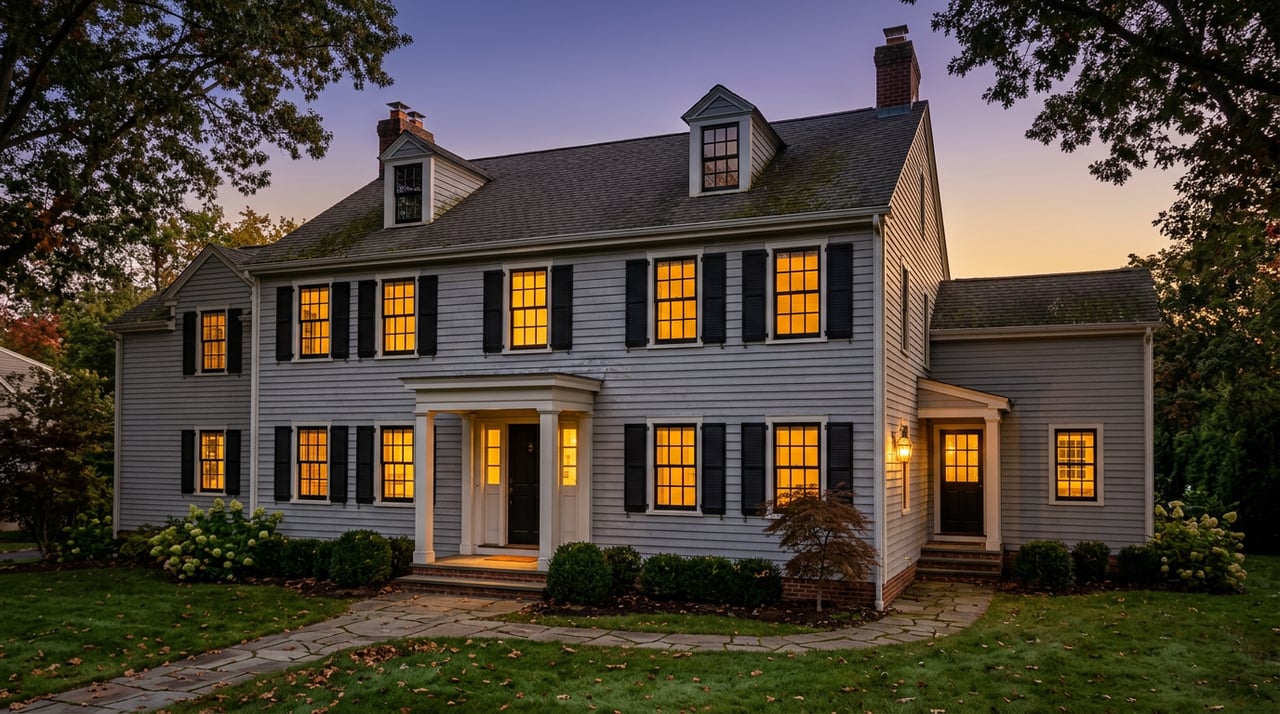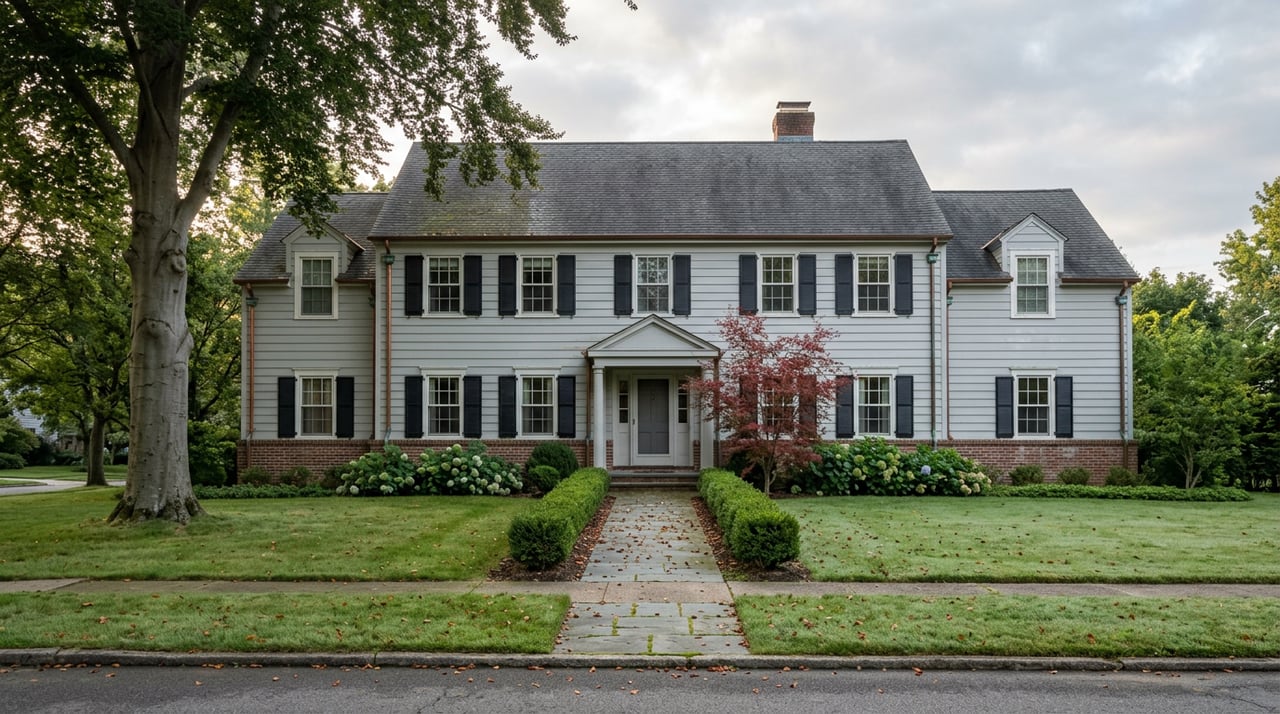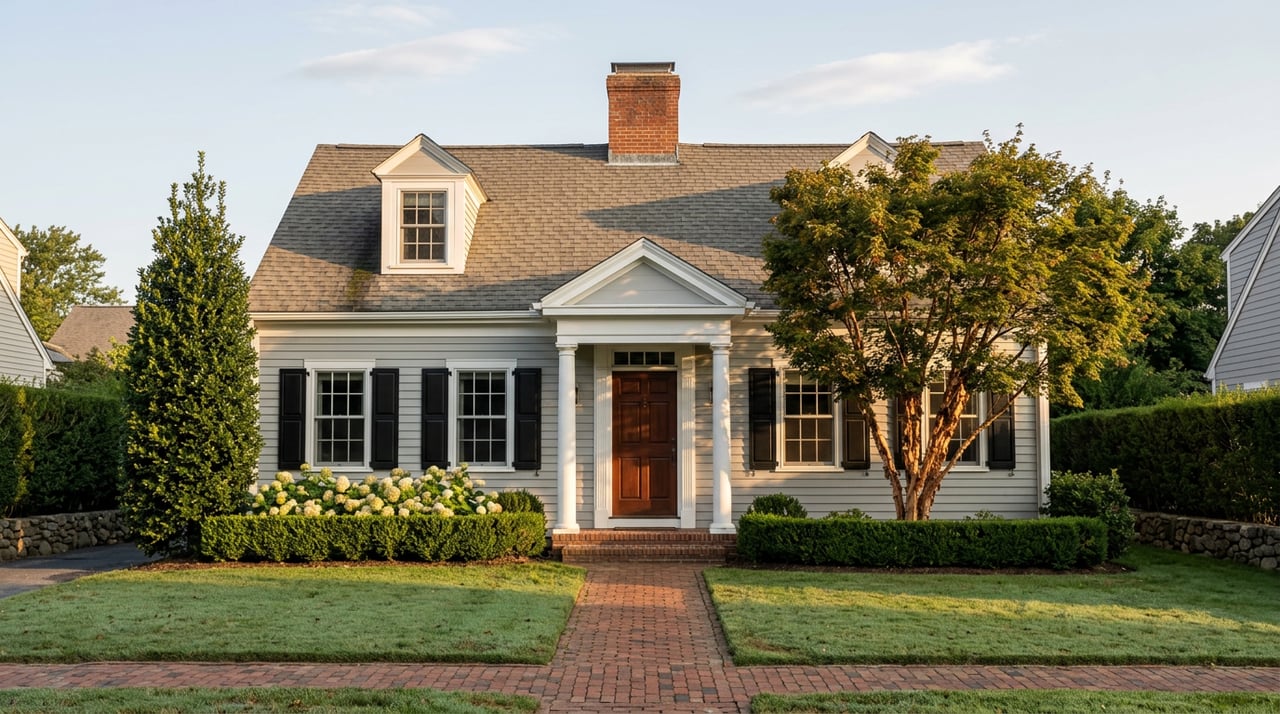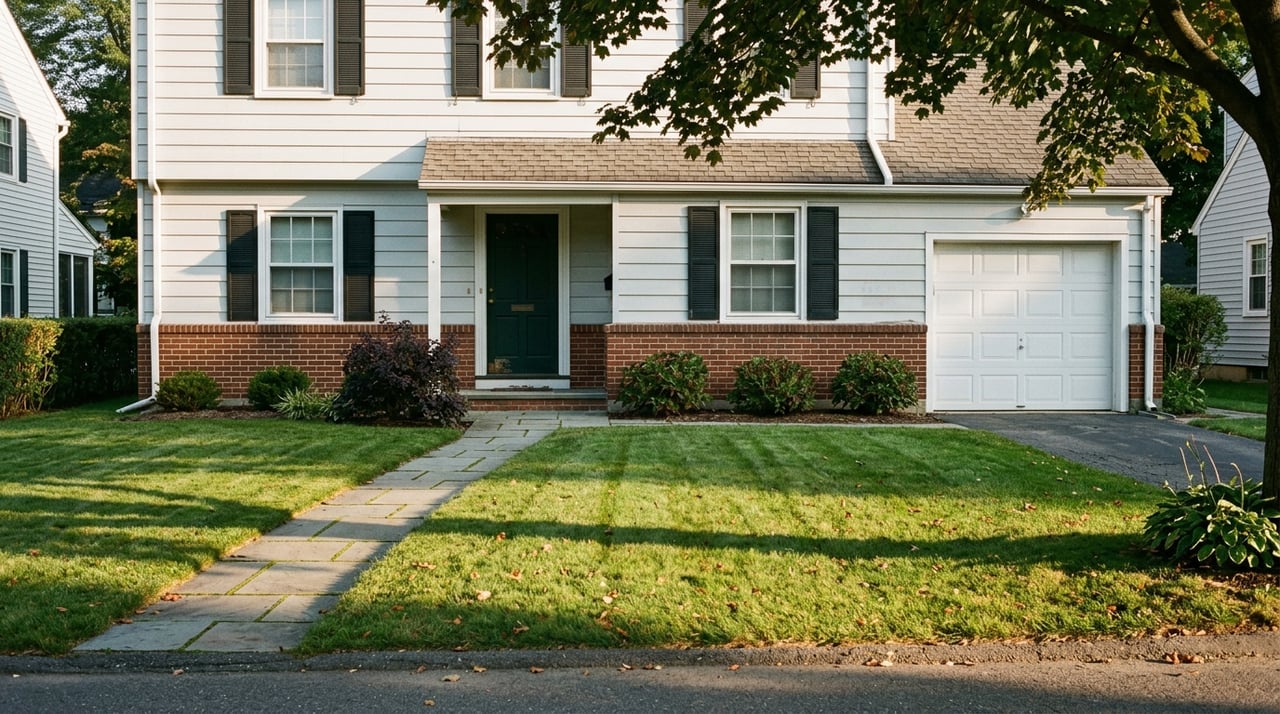
Drive west on Route 9 through Natick and the town changes shape every half mile. Slab-foundation ranches give way to Victorian gables near the arts school on the hill, then to shingled colonials on streets named for Robin Hood's men, then to grand homes set back from the road with the kind of lot size that doesn't show up in a listing photo. It's the same town. It is not remotely the same market.
That's the part the median price doesn't tell you.
The number that stops meaning anything
Ask a portal what Natick homes cost and you'll get a single figure. Over the three months ending June 2026, Natick's median sale price sat at $899,000, with homes fielding about four offers on average and closing in around 17 days. That number gets repeated everywhere: in listing agent scripts, in relocation packets, in the mental math out-of-state buyers do before they've seen a single street.
The problem is what that number is standing in for. Recent neighborhood-level figures put Saxonville's median around $574,950. Linden Square runs closer to $1.549 million. Fells sits near $1.995 million. Cliff Estates comes in around $4.123 million.
That means the gap between the cheapest and most expensive corners of Natick is more than seven times over, wider than the gap between Natick's town-wide median and Newton's, where Redfin reported a $1.45 million median in March 2026. Buyers spend months agonizing over which MetroWest town to choose, weighing Natick's roughly $900,000 median against Framingham's $728,000 the same month, as if town borders were the meaningful line. Inside Natick alone, the spread is bigger than that entire regional comparison.
| Area | Approximate median (2026) |
|---|---|
| Saxonville | ~$575,000 |
| Framingham (town-wide) | $728,000 (March 2026) |
| Natick (town-wide) | $899,000 (3 mos. ending June 2026) |
| Linden Square | ~$1.55 million |
| Fells | ~$2.0 million |
| Newton (town-wide) | $1.45 million (March 2026) |
| Cliff Estates | ~$4.1 million |
Choosing a town tells you almost nothing about which Natick you're actually buying into.
Six villages, six different post-war stories
The spread isn't random. It's the residue of how Natick got built, decade by decade, in distinct pockets that never merged into one housing stock.
Wethersfield, north of Route 9, is a textbook 1950s Campanelli ranch development: slab foundations, no basements, compact footprints built fast and cheap for the postwar boom. It remains one of the more accessible entry points in town for exactly that reason. Walnut Hill, north of downtown, is home to Victorian-era houses near the Walnut Hill School for the Arts, the kind of older build era that tends to come with taller ceilings and deeper lots. Sherwood, in West Natick, is colonial-style construction on Robin Hood-themed streets known for its lack of through traffic, the sort of quiet street pattern that shows up in what buyers are willing to pay for privacy. Eliot Street, along the Charles River, holds some of the town's oldest homes. Little South, near the Town Common, is a mix of early-1950s modest homes and older farmhouses that predate the postwar boom entirely.
None of these areas were built to the same standard, on the same lot size, in the same decade. A single town median flattens a Campanelli ranch and a riverfront colonial into one number, which is exactly why that number is the wrong tool for comparing what your budget actually buys.
The corridor that just finished rebuilding itself
Here's the piece that's changing right now, not something baked into last year's sales data.
Natick Center Station, on the MBTA's Framingham/Worcester Line, just came out of a renovation that took more than five years and roughly $40 million to complete. The station ranks among the top 25 percent busiest commuter rail stops in the entire MBTA system, and until last year it was also among the busiest stations that didn't meet ADA accessibility standards. The rebuild added two new elevators, accessible ramps, six stairways, and full-length high-level platforms so riders can board without stepping up into the train.
The eastern sections of both platforms opened at the end of July 2025, with a ribbon-cutting that August. By February 9, 2026, the outbound platform had opened in full, along with a direct pedestrian connection to the Cochituate Rail Trail, a four-mile shared-use path that now links Natick Center straight through to the village of Saxonville in Framingham without a car. Before that connection existed, cyclists and walkers reached the trail by detouring through Mechanic Street. Now it's a straight shot from the platform, with only the final stretch of the inbound platform still finishing up construction.
What that means for buyers is straightforward and easy to miss if you're only watching town-wide numbers. A commuter rail stop that just became fully accessible, with a completed trail connection and a station design already built to accommodate a future third express track, is not the same amenity it was two years ago. Demand tied to that specific walkability, being able to leave a front door and reach a platform without a car, is a different variable than what a Cliff Estates buyer is paying for space and privacy, or what a Wethersfield buyer is paying for an entry-level price point. Town-wide medians can't isolate that variable because they average all three markets into one figure.
What this means if you're cross-shopping towns
If you're comparing Natick to Newton, Wellesley, or Needham on a spreadsheet, the town median is doing you a disservice in both directions. It undersells what a walk-to-rail property near Natick Center can command now that the accessibility work and trail link are finished, and it oversells what a Wethersfield-style starter home costs relative to the number you saw on a portal.
The more useful comparison isn't Natick's median against Newton's median. It's Natick's walk-to-rail corridor against comparable transit-adjacent pockets in Newton or Wellesley, and Natick's 1950s ranch inventory against similarly-scaled starter stock elsewhere in MetroWest. As of spring 2026, Natick homes overall had a reported median of 14 days on market against 20 days for Middlesex County and 26 days statewide, but that pace almost certainly isn't even across a $574,950 ranch and a $4.1 million riverfront colonial. Fast-moving listings in one village can sit differently than fast-moving listings in another, even inside the same town-wide statistic.
How to actually pull comps in Natick
If you're serious about buying here, the town median is a starting point for small talk, not a number to budget against. A few adjustments make the search more accurate:
- Pull comparables by village, not by town. A Saxonville comp tells you nothing useful about a Cliff Estates listing.
- Note the construction era before you rely on square footage alone. A Campanelli-era slab ranch and a Victorian on Walnut Hill can share a bedroom count and still be entirely different properties to finance, insure, and renovate.
- If walkability to Natick Center matters to your daily routine, factor in that the corridor just changed. Comps from before the February 2026 platform completion and rail trail connection may already be outdated for that specific pocket.
- Ask what stop actually matters for your commute. The Framingham/Worcester Line makes two stops in Natick, Natick Center and West Natick, and they sit in different parts of town with different walking radii.
A few questions worth asking directly
Is the price gap between Natick villages just about square footage? No. Lot size, construction era, and proximity to amenities like the rail line all move independently of square footage. A larger home in an older, less walkable pocket can price below a smaller one near the newly-rebuilt station.
Does the finished MBTA accessibility work mean prices near Natick Center will keep rising faster than the rest of town? The infrastructure itself, full accessibility, a completed rail trail link, and design space reserved for a future third track, are new advantages the corridor didn't have two years ago. Whether that keeps translating into faster appreciation is something worth tracking deal by deal rather than assuming from a single quarter's numbers.
What's the practical difference between Natick Center and West Natick as commuter stops? Both sit on the Framingham/Worcester Line, but they anchor different neighborhoods with different walking distances to shops, the Town Common, and the trail network. Which one matters more depends on where in town you're actually looking.
If you're trying to figure out which version of Natick actually fits your budget and your commute, that's not a spreadsheet exercise. It's a village-by-village conversation, and it's exactly the kind of local read Judy A. Korzenowski has spent years building for buyers moving into Natick and the rest of MetroWest. Reach out for a complimentary consultation and market valuation before you let one town-wide number decide where you start looking.